Showing posts with label ePatient. Show all posts

Friday, September 15, 2017

Death & Bereavement In The Digital Age - A Panel Discussion At Stanford #MedX 2017

It's panel eve at Stanford Medicine X 2017.

Over the years, I've convened a few panels here, been a guest on many of them and spoken on the main stage. I've had many a powerfully moving informal conversation in the halls of Li Ka Shing Learning and Knowledge Center, and by the pool of the Palo Alto Sheraton (MedX's ad-hoc after-hours party).

With tomorrow's panel however, I jump straight into the deep end, and come full circle with one of the defining events of my childhood: the untimely death by suicide of my father when I was 4 years old in a family and a society that had perfected the "just get over it and move on" solution to grief and loss. After losing more people than I can count, I have had to unlearn everything that was drilled into me about Loss and figure out how to grapple and play with it in unfamiliar and ultimately much healthier ways. Social media and in particular, my experiences as a member of the #BCSM community on Twitter have been instrumental in helping me on this path.

Envisioning the panel and then working with Alexis Roberts Keiner, Liz Salmi, Michael Fratkin and Jim Rosenberg (who, sadly will not be at Stanford with us tomorrow) to shape it has already taken me on a spelunking expedition to the depths of my soul. Our collaboration sessions lit up those cavernous walls to reveal the most asphyxiating of pain juxtaposed with the most immense beauty. Our shared gallows humor, tears and tenderness got all of us through our preparatory sessions, and I am so proud and thrilled to see our work come alive and share it with the world tomorrow.

Thank you Alexis for being the catalyst, thank you Liz for being the connector, thank you Michael for being the accelerator, and thank you Jim for being the aggregator.


Added after the fact: the video of our panel.


Here is the abstract:

Death And Bereavement In The Digital Age


In 2016, people from around the world flocked to social media to mourn beloved celebrities, including David Bowie, Muhammad Ali, and Prince.

Meanwhile, for years and on a more intimate scale, individuals have been using (and continue to use) digital tools in creative ways as they experience serious illnesses, the end of life, loss, and bereavement:

-A baby dies suddenly and a mother informs her community on Facebook. In-person and online gathering, mourning, and healing ensue.

-A woman with advanced cancer tweets her illness and decline. Critics in national newspapers blast her actions, but her followers credit her with helping them.

-Cancer advocates die, and people who had only ever known them through Twitter gather online to mourn, celebrate their lives and … heal… and, manage their own heightened fears of dying and death—common emotions that accompany a cancer diagnosis.

-In the face of increasingly corporatized health care, a palliative care physician quits his job to better serve his rural community… he develops a way to help his patients, his colleagues, and himself more humanely tackle end of life issues through a combination of in-person and online video interactions/telemedicine...

-In the span of four months, a husband/father grapples with the progression from his wife’s sudden terminal diagnosis to her death. In the aftermath he develops a way—through a digital storytelling platform—to break down the taboos in talking about end of life and help people address the isolation, confusion, and stress that is such a painful part of the experience.

In this panel discussion, Liza Bernstein, Liz Salmi, Michael Fratkin M.D., Jim Rosenberg, and Alexis Keiner will explore the ways in which patients, caregivers, health care professionals, and anyone affected by loss are using and designing digital tools to address death and bereavement.

After each panel member introduces themselves and their personal connections to the topic, the conversation will focus on the impacts of our increasingly connected, digital lives on facing death, end of life and grief.

Questions we will address include:

-How has the digital age impacted death, dying and bereavement?
-What does the ubiquity of social media and digital tools add or subtract?
-How do online communities manage loss—and is it any different from managing loss “in real life” (IRL)?
-Are screens a way to distance ourselves from the realities of death, or can they help us cope? For example, by providing new ways to demystify and attenuate fears; to grieve, commemorate and commune; to create legacy and heal.

This carefully curated panel will bring humanity, dignity, kindness, and a healthy sense of humor to this sensitive but important topic.

Monday, April 25, 2016

Thank You, Jody

This post is in response to the recent announcement that Jody Schoger, co-founder of the #BCSM Chat and Community, has entered home hospice as her treatment is no longer effective. Jody has metastatic breast cancer.

I posted this on Facebook but want it to live here on my blog as well.

*  *  *  

Dear Jody,

The impact you have had on my life is profound and far-reaching, all the more so because you were always "just" being you, doing what you do.

Jody, you're The Person who quickly "saw" me, reached out and welcomed me to the wild wild world of Twitter in late 2010/early 2011.

You encouraged, mentored, and supported me in so many different ways.

Here's one of the most important: I don't know if you know this, but you are one of the advocates who set the example and inspired me to cease posting anonymously and take the terrifying step of being Out to the world at large as a person who has had cancer. And this was at a time when I was so extremely vulnerable and fragile in body, mind and spirit, just months after finishing treatment and surgeries for my 3rd cancer.

You are responsible for helping me somehow make it through that terrible day I experienced at the first breast cancer conference I naively attended: C4YW, February 2011: I didn't understand that attending a conference could trigger me, because I didn't understand that I had PTSD from Medical Trauma. Your DMs (direct messages) with me that day were a precursor to what we came to fondly call the #BCSM batsignal.

A few months later, you encouraged me to apply to Stanford Medcine X, we were both accepted, and you offered to be hotel roomies. The first time we spoke on the phone (to make those arrangements) we joked about hopefully not being axe murderers :-)

This photo of you is from that hotel room, after we had finally met in person. I will never forget how much FUN we had, feasting on delicacies we picked up at the nearby Trader Joe's, and goofing off by speaking in French accents.


I feel like I captured your sense of humor, joie de vivre and playfulness in this shot. Such a necessary contrast and corollary to the seriousness of our purpose.


The other photo symbolizes, to me, the profound impact you have had on the world beyond Breast Cancer. 

You, Hugo Campos and myself at that first Stanford Medcine X (technically, it was Med2), members of that group of founding ‪#‎ePatients‬ who, thanks to Larry Chu's invitation and challenge, came together to co-create and participate in an academic medical conference as equal stakeholders.


Jody, know that I carry you with me always.

Thank you for lighting the path and showing me the way

All my love and gratitude,

Liza
Update, Wednesday, May 18, 2016: I woke up to the news that Jody died this morning. Please read this beautiful tribute to her by #BCSM's co-founder, Alicia Staley: "Good Night, Jody."

Monday, November 11, 2013

QuickPost :: Design And Mental Health


Image from http://thoughtsofdepression.com/
Another great find at the intersection of Design, Medicine and Technology, via the ever-reliable Co.Design.

Take a look at this piece about the MindBrowser project which uses Design to tackle a common, often devastating and/or fatal, and generally misunderstood and stigmatized illness—Depression.

In the words of the article:
"A clickable online map narrates the thoughts and feelings of a person going through a depressive episode in an attempt to destigmatize a widespread mental illness."

Designer Kim Haagen explains it as follows on the Thoughts Of Depression site:

About the MindBrowser by Kim Haagen. Screenshot from http://thoughtsofdepression.com/


Haagen demonstrates how the tool works in this video:


Thought of Depression - The Mind Browser from Kim Haagen on Vimeo.
A research on the social effects of depression led to the concept for the Mind Browser. A tool that helps develop emphasis towards the depressed ways of thinking.


Per the Co.Design piece:
"It's still in its prototype stages, existing mainly in video and concept form, but once it’s fully realized, the MindBrowser could be a powerful tool in combatting stigma and ignorance. Haagen has plans to apply the MindBrowser format to all existing mental illnesses."

I am a fan of the "out-of-the-box," curiosity/research-driven and collaborative approach... and, it's always so inspiring when a patient takes on the task of shifting the needle in creative and effective ways. Haagen tells Co.Design about the roots of her project:
“Throughout my life I have had different kinds of experiences with depression,” Haagen tells Co.Design. Out of a personal need to speak openly about the illness, she began to interview depression sufferers and psychologists about their experiences.

Also, I can't help but imagine how extending and building on this approach might work/help if it were to add further participatory components and even evolve into an app/tool that individual patients, psychologists, doctors and caregivers might use.


Wednesday, April 17, 2013

More Collaborative Medicine In Action, #BCSM Edition, Part Two.

It began with a post I caught on Facebook:


Tweets ensued, including:
And now, on the #BCSM website, a second opportunity for patients to contribute to the advancement of medical knowledge (I wrote about the first one here). Yes, that does sound pretty grandiose! What I mean is this: when you are experiencing the type of side effects a drug like Tamoxifen can induce, you can discuss them with your oncologist, you can vent about them at support groups, you can blog and tweet about them ad nauseam. That's all fine and dandy....

But to be able to give that information to a physician who not only cares deeply, but who is planning to use that information in a presentation she is giving at a medical meeting.... well, that does get you thinking pretty big.

I continue to be excited and inspired by what we can accomplish when we harness technology to facilitate change.


Friday, April 12, 2013

Collaborative Medicine in Action


It began with a tweet, that I RT'd after reading the related post on the #BCSM website.

Others chimed in, including:


And:

I've excerpted the introduction from that post here:
Unique Opportunity for Patients and Advocates! 
By DrAttai On April 11, 2013 · 13 Comments 
Here is a unique opportunity for patients to have their voices heard, BEFORE a clinical trial gets approved. Many thanks to Dr. Julie Gralow (@jrgralow) from the University of Washington for asking for advice from our community. 
Patient Survey Regarding Follow-up of Early Stage Breast Cancer  
We are seeking patient input through this survey to help in planning a national clinical trial designed to determine how to optimally screen for breast cancer recurrence.
For details about the clinical trial being planned, please read the rest of the post. It's important and fascinating. 

Just as important and fascinating is the ensuing dialogue, much of which was sparked by the last  (and only open-ended) question in the brief and easy Patient Survey. I saved my answer to that question, and am reproducing it here: 
"Last Question: This study would allow us to study many other breast cancer “survivorship” questions during long-term follow-up. What are the main cancer and/or treatment-related problems that you think we should consider including in this study? (for example, this might include difficulty concentrating/”chemobrain”, menopausal symptoms, numbness/tingling, depression/anxiety, pain, weight gain, sexuality/body image, fear of cancer returning)."
"All the items mentioned in the above question should be included.

I would be most interested in seeing how you would approach studying these additional important issues so as to get actionable data.

People who survive early stage BC after receiving adjuvant treatment (I have had three primaries myself, so I know from experience) end up with a host of long term side effects, from chemobrain/cancerbrain to higher instances of anxiety/depression/"ptsd"-symptoms, etc. I know you know this too.

Another aspect of long-term survival is the psychological impact of being watched so carefully by one's medical team (pro = more likely to find a recurrence or relapse sooner; con - heightened anxieties, etc due to fear of recurrence). Being followed every few months with blood tests could both give a sense of reassurance and heighten the anxieties. This also contributes to the isolation many survivors experience. You have to keep going back for follow-up visits, keep wondering if IT has returned, while most everyone else you know continues with their usual routine.... This is what you just have to learn to live with.

Meanwhile, now that I am in the position of basically having to rely on hoping I don't get any symptoms, it is terribly anxiety-producing. My oncology office happens to order tumor markers during long-term follow up, so if mine happen to go up, I will be one of those few women who will have an additional possible clue as to whether I have developed mets. I also understand there isn't always a 1-1 correlation between marker levels and the development of mets. More uncertainty!

This is a great idea for a study. I just hope there will be other more reliable pathways to detecting Early Stage Mets (for example, non-increased-radiation studies: I'm tapped out for PET and CAT scans, per my oncologist, due to the numerous scans/mammos, etc I've already had in my 19 yrs of 3 BC primaries. We will only use those in an emergency at this point.). We need better tools!

I appreciate your thoughtfulness and intelligence in reaching out to us in these preliminary stages of your trial. My name is Liza Bernstein and I can be reached via Twitter at @itsthebunk. I'd be happy to contribute further to your thinking process during this development process and answer any questions you might have, if you were so inclined.

Thank you,

Liza Bernstein"

Not surprisingly, some of my concerns are echoed in the comments from other survivors, and the great thing is that the researchers are addressing them as they come up. 

Surely this type of dialogue will help researchers design even better and more relevant studies. It certainly empowers survivors to join in the process. The ensuing dialogue gives me hope that our ideas and concerns will be seriously considered.

This is an example of what collaborative medicine, fueled and enabled by social media and technology, could look like.


Tuesday, February 12, 2013

On The Importance Of Being Disruptive


Excellent quote from ePatient Advocate, Regina Holliday, from her post about her petition to Hallmark to create hospice cards. 

She is being noticed. 

Forbes has picked up the story, and the petition is gaining signatures.


Innovation requires this kind of intelligent courage too.

I have learned as an activist, sometimes you must be disruptive to be noticed.  Only when you are noticed can you be heard. 
~Regina Holliday


Monday, February 11, 2013

Mademoiselle X and the Pre-Op

Recently, a young woman I've been mentoring through her Breast Cancer journey -- I'll call her Mademoiselle X -- asked me to help her prepare for her post-double mastectomy revision surgery.

Mademoiselle X's initial double mastectomy surgeries did not leave her with a good result. Thankfully, nothing "went wrong" from a health perspective... she healed very well, there were no infections or complications... but for the fact that the implants she received seemed like they had been intended for someone requesting a drastic (and I mean DRASTIC) and intentionally un-natural looking breast augmentation.

After the usual insanity and extreme distress of the diagnosis, the chemo, the fears of infertility due to said chemo, and the ordeals of her first two surgeries, the last thing Mademoiselle X wanted and needed was to have to revisit any and all of this as a once again vulnerable patient, dependent on surgeons to leave her with results she would have to live with for the rest of her life. But, given the situation, a revision was what she desperately needed.

Before her pre-op, we discussed her fears, needs, wants, expectations. We also brainstormed questions and tactics to ensure she would get the information she needed from the surgeon, all the while getting said surgeon to hear and understand exactly what she did and did not want.

I coached her to talk about precise, specific details, and to be explicit about her needs. This, no matter how polished, professional, educated, strong, or valiant you may be, is no easy task, especially when you are going through this for the nth time, and your new surgeon is... well... a Brilliant Surgeon (i.e., super achiever, technical guru, tending towards uber-human). Hence our coaching sessions.

I am sharing here our exchange of texts immediately following her pre-op with the surgeon:
Mademoiselle X: Doc scared the crap out of me, talking about 6-8 percent rate of infection where he'd have to remove implant altogether and I could have flat chest and droopy skin for 3 months before another surgery with loads of scarring... like the worst of the worst Scar Project pics you've seen. I'm so desperate to be smaller, but now I'm scared.
Me: They always have to tell you the scary side effects and scare the crap out of you. 6-8% infection rate also means 94-92% NON infection rate. You don't smoke, drink abusively, or have diabetes... you are healthy and will have to be scrupulous about wound care etc... which you will be anyway. I don't want you to think I am being dismissive... just trying to give you some perspective. Sorry you have to go there.  
This brought me straight back to my initial visit with my oncologist after my first breast cancer diagnosis. She was recommending chemo for me, but had to give me the list of potential side effects. One of them was LEUKEMIA. What? To kill the cancer inside my body, you are prescribing a drug that could possibly cause another, lethal, cancer? How am I supposed to breathe after hearing that, let alone continue with my life?

The toxic levels of anxiety we experience as cancer patients leave our nerves raw and exposed. It takes time and diligence to heal that frazzled mess, and in the case of Mademoiselle X., the last thing she could have understood rationally in the moment was what the risk of that side effect really, truly was, given her particular circumstances.

I know there's a responsibility to disclose these potential side effects, but we patients need to learn to interpret them and gain some perspective on what they really mean. No easy task when you are in the throes of your cancer journey, but a crucial one nonetheless. This would be a useful tip for caregivers and loved ones too.


Friday, August 12, 2011

Coping Lifeline: My Treatment Notebooks

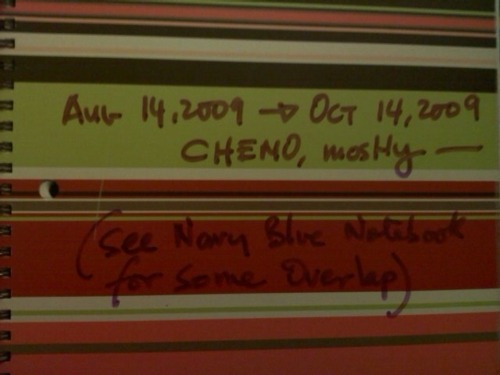
One of the things I did to keep some kind of sanity was to dedicate a series of notebooks to my treatment and healing process. On each notebook's cover I'd write the time spanned within. Anything to help me stay organized.
image
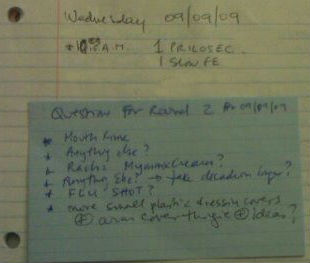
I used the notebook to take any and all notes before, during and after medical appointments, and if I happened to write a note on some other piece of paper, I'd tape it on the appropriate page to keep everything together....
image
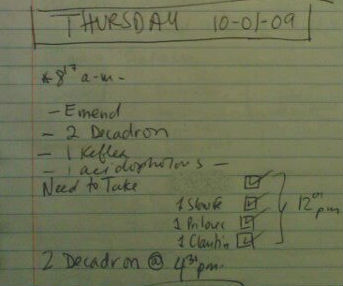
...I'd also use it to track the cornucopia of medications you end up taking when going through chemo and after surgery... each one has its own lifecycle, so I'd end up creating a list with open checkboxes that I'd fill in once each drug was taken.
image
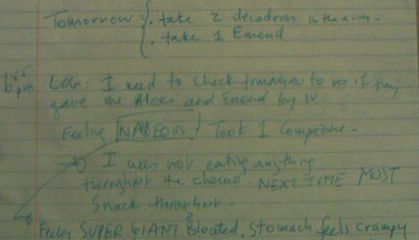
This was very handy when trying to stick to the prescribed schedule for certain drugs:  I learned the very hard way that if you stuck to the schedule you could gain more power over a given side effect, and when that side effect is intense pain or nausea you definitely want to do everything you can to maximize the "helper" meds. Tracking the meds was also helpful when I needed to talk with my MDs and/or Nurses about side effects: I'd be able to give them the info they needed to help me.
image
Another thing the notebook was great for was tracking phone calls, messages and conversations with my medical team. If I had a question about a side effect between two chemo cycles, I'd write it down, call the Doc's office and if I had to leave a voicemail, I'd note it in my notebook. Then, when they called back I'd know why they were calling me! (If you've gone through chemo, you've probably had at least one or two episodes of "chemo brain," yes?!)
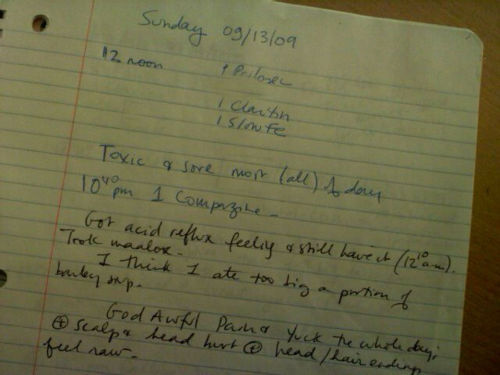
I would also write notes to myself as I did in one of the pictures I attached -- "Feeling NAUSEOUS! ... I was not eating anything throughout the chemo. NEXT TIME MUST snack throughout!" This helped me learn from my mistakes and improve my experience as best as possible.
image
Finally, as I write this, I'm glad I did this and kept the notebooks, as I'm able to refer to them and share some tips with anyone whom (I think it's "whom," not "who"!) this might help.