Friday, February 10, 2012

Goodbye Rachel and Susan

On Monday, 02/06/2012, the #BCSM community lost two wonderful women: Rachel Moro and Susan Niebur. In a twist of cruel and bitter irony, they died within hours of each other, on the very day we gather for our tweetchat. That evening's chat was no doubt some kind of online interaction history in the making, as we came together to honor them, grieve, and support each other. Here is some food for thought:


Both Rachel and Susan were brilliant writers, and their work is a must read for anyone interested in Breast Cancer. Susan's blog is Toddler Planet and on Twitter @whymommy. Rachel's blog is The Cancer Culture Chronicles and on Twitter: @ccchronicles.

ADDENDUM: Here is the link to the Transcript of the #BCSM Chat in Rachel and Susan's honor.

Return of the Fatigue Monster

I have been battling the Fatigue Monster for the past five days, and when he (FYI, I arbitrarily designated this Monster as a male of the species; it could just as easily have gone the other way) hits hard —he must have copped some serious roids lately—I get to feeling like I must have had me a good ole round of chemo, just without the nausea. 
If you’ve been there, this might sound familiar: every cell in your entire body hurts and aches, on top of which you could swear someone yoked you to an anvil when you weren’t looking, because walking has somehow been replaced by the excruciating dragging around of your now pathetic, humiliated self.
And, of course, nothing really helps you feel better fast enough, not Advil, not a nap, not a “walk,” not caffeine, not fresh organic food, green tea or mac ‘n cheese, not chocolate, not Western medicine, not Integrative or Complementary either, not yoga, not meditation, not anything. The Fatigue Monster has prevailed and you are now its lowly slave.
This becomes all the harder to bear when you are already two years out of chemo, and one year out of a couple of major surgeries: You feel like you should be so much better by now. And if you’re anything like me, you have always been a striver, a do-er, a putter of much pressure on yourself… a person whose will and tenacity had made it seem like you could get through all sorts of unusually harsh life-events and come back to The You You Thought You Knew—you know, the one with all that determination, energy, good cheer, and…. drumroll….. STAMINA. Aaaargh..
(January, 2012).

Twisted Path

I don't know why cancer hijacked my life three times.

I have pondered the question ad nauseam and on any given day can tell you that "there's a reason for everything," or that "%$@# happens" or both or neither.

I don't have a family history of cancer, I've always eaten on the healthier side (I actually liked broccoli as a kid) and have always been an active person. Ironically, each time I was diagnosed I was otherwise Healthy -- yes, definitely Captain Healthy with a capital H for emphasis.

And throughout these three episodes, the only thing that ever made me "sick" was the treatment to rid me of the lethal disease. That's one of the reasons why the term "hijacked" seems so appropriate.

Being sick, being a patient, spending hours and hours and hours in Doctors' offices, putting medication and chemicals in my system..... none of these things were ever on my radar or even on the most remote edges of any wishes, desires, dreams and/or plans I might have had for my life. The notion of a hand of cards makes some sense. I have been dealt some terrible ones.

It's complicated. I've had cancer three times--three primaries, i.e., each one brand new from scratch--but each time it was caught early. That's considered lucky.

But having a body that allowed tumors to form--that's not lucky. And having to go through treatment to remove it and prevent it from spreading, that's not lucky either. State of the art** treatment is still a brutal combination of Slash, Burn and Poison (surgery, radiation and chemotherapy), aka Torture. I consider it Barbaric.

Then again, being diagnosed early, having the most outstanding medical team, having access to treatment, that's lucky because it has now literally saved my life three times.

Surviving cancer as a young woman is lucky, but it's also "unlucky" because you have to live with the aftershocks and the uncertainty (will it come back?). And on and on it goes. As I said, it's complicated.

Having to stop your life to fight cancer--talk about a source of anger and frustration. But I know I have grown and learned and continue to do so because of it.

I know that the lessons are about things like acceptance, surrender, and the true meaning and purpose of inner strength amongst other Big Life Questions.

Cancer has been a catalyst for my examination of these concepts over the past 15 years, and I realize now that they have been in and around my consciousness for as long as I can remember.

I never wanted to be sick, but I have always wanted to understand life. What a twisted path.

--Thanksgiving, 2009: written about a month after my last round of chemo.

By The Way: I don't consider cancer to be a "gift," and I don't use the words "acceptance" and "surrender" lightly!

**I wrote this in 2009. Since then I have learned a lot about genetics and targeted treatments (such as Herceptin for the subset of Her2Neu positive breast cancers) that don't compromise your entire system, and the research that is being done in that area. I highly recommend the incredible Pulitzer Prize-winning book The Emperor of All Maladies, by Siddartha Mukherjee for a comprehensive history of cancer, the "War on Cancer" and great insight as to where research is headed.

The Shadow

Gaaaaahhhhhh!!!
Breast Cancer, like any other traumatic event, will not go very far out of its way to gift you with its very own brand of PTSD whether you like it or not.

A wise man I know calls one aspect of this "the shadow of cancer." As in, once you're done with treatment, you're never "really done," because you have no way of knowing if it will come back or if you'll get a brand new one, or .... not.

That is something you have to learn to manage, and 30 days of 24/7 ubiquitous pink can get in the way of that.

As a fellow traveler on the verge of tears said to me the other day, as we both left the oncology office, "I'm just trying to live my life, and everywhere I go, it's PINK."

This brave woman is in great health. She's 3 years out from her battle with BC, but that relentless shadow still terrifies her. (October, 2010)


Monday, October 3, 2011

Definition of Home

"Her skills were so rare, so needed for the poorest of the poor, and even at times in the royal palace, that she felt valued. Wasn't that the definition of home? Not where you are from, but where you are valued?"
― From Cutting for Stone by Abraham Verghese regarding the character Dr Kalpana Hemlatha (aka, Hema) reflecting on her adopted home in Addis Abeba, Ethiopia vs Madras, India.

Wednesday, September 28, 2011

Service and Joy

“I slept and dreamt that life was joy. I awoke and saw that life was service. I acted and behold, service was joy.”
― Rabindranath Tagore

From goodreads.

Tuesday, September 13, 2011

Compassion Is Good For Your Health

"That human beings have an innate instinct for compassion is not something anybody needed science to prove, of course. But research is beginning to answer one vexing question: Is compassion a fixed personality trait, locked in by nature and nurture, or can higher states of compassion be cultivated? Scientific studies suggest that we can learn to be compassionate and that compassion can even physically change the wiring of our nervous systems."

This is from an interesting article by Larry Gallagher in the July/August 2011 issue of OdeWire

Friday, August 12, 2011

Coping Lifeline: My Treatment Notebooks

One of the things I did to keep some kind of sanity was to dedicate a series of notebooks to my treatment and healing process. On each notebook's cover I'd write the time spanned within. Anything to help me stay organized.
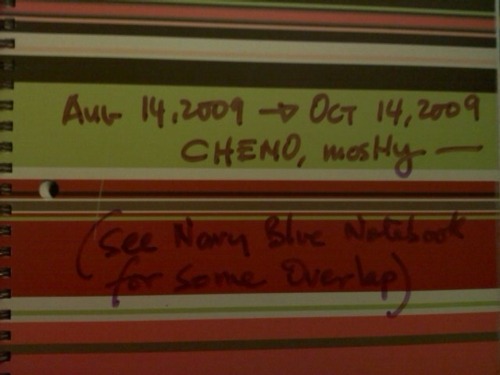
image
I used the notebook to take any and all notes before, during and after medical appointments, and if I happened to write a note on some other piece of paper, I'd tape it on the appropriate page to keep everything together....
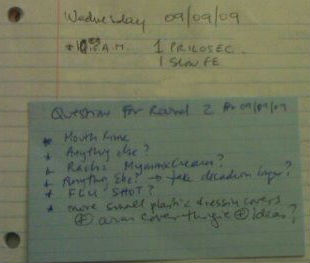
image
...I'd also use it to track the cornucopia of medications you end up taking when going through chemo and after surgery... each one has its own lifecycle, so I'd end up creating a list with open checkboxes that I'd fill in once each drug was taken.
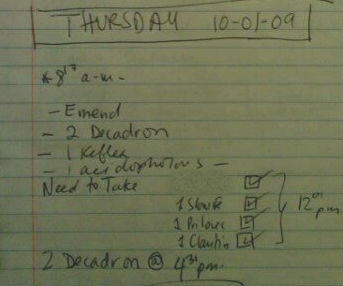
image
This was very handy when trying to stick to the prescribed schedule for certain drugs:  I learned the very hard way that if you stuck to the schedule you could gain more power over a given side effect, and when that side effect is intense pain or nausea you definitely want to do everything you can to maximize the "helper" meds. Tracking the meds was also helpful when I needed to talk with my MDs and/or Nurses about side effects: I'd be able to give them the info they needed to help me.
image
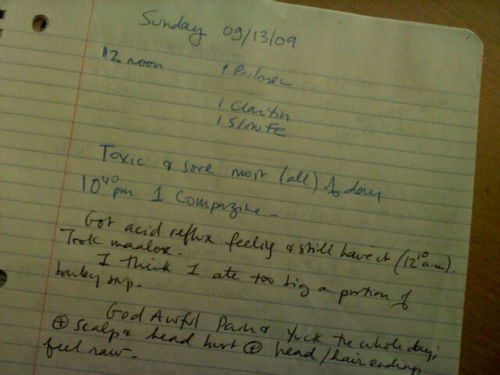
Another thing the notebook was great for was tracking phone calls, messages and conversations with my medical team. If I had a question about a side effect between two chemo cycles, I'd write it down, call the Doc's office and if I had to leave a voicemail, I'd note it in my notebook. Then, when they called back I'd know why they were calling me! (If you've gone through chemo, you've probably had at least one or two episodes of "chemo brain," yes?!)
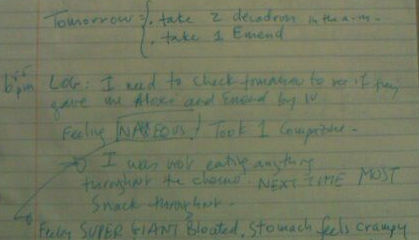
I would also write notes to myself as I did in one of the pictures I attached -- "Feeling NAUSEOUS! ... I was not eating anything throughout the chemo. NEXT TIME MUST snack throughout!" This helped me learn from my mistakes and improve my experience as best as possible.
image
Finally, as I write this, I'm glad I did this and kept the notebooks, as I'm able to refer to them and share some tips with anyone whom (I think it's "whom," not "who"!) this might help.

Sunday, March 27, 2011

Science and Nature

To science's deep frustration, nature regularly confounds our attempts to predict its next move.

― Susan Casey, The Wave.

Thursday, March 10, 2011

On Death Valley

image“The Valley was a place made for loners. You could share it only with someone who viewed it in the same perspective-not as endless miles of coarse, dead landscape but as a starkly beautiful wilderness teeming with life. To him it seemed almost sentient, as if deep within its ancient rock was something that approximated a soul.”

― Bill Pronzini, The Other Side of Silence
― Image source.